Tinned Copper Cable Lugs
2. Types: OT, UT and DT.
3. Cable cross-section: 1.5–1000 mm² across the listed types.
4. Stud sizes: M4–M20, depending on type.
5. Barrel options: short or long, depending on type.
6.Lead Time: 7–10 working days
7.Customization: Flexible OEM/ODM options
Tinned Copper Cable Lugs for Power Distribution
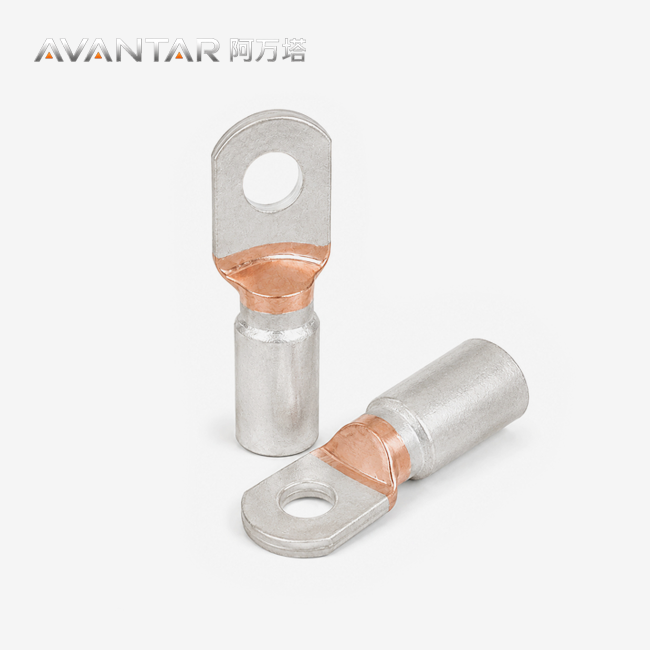
Avantar's tinned copper cable lugs are made in Guangdong, China, with T2 electrolytic copper (C11000) and a tin-plating thickness of 3–5 μm for normal conditions and up to 8 μm for chemical, high-humidity, or coastal sites. You can get these lugs in OT ring, UT spade, and DT tubular pin styles. They can fit wire sizes from 1.5 mm³ to 1000 mm³ and stud holes from M4 to M20. ISO 9001:2015, RoHS, DIN 46235, UL 486A/B, and IEC 61238-1 all say that they are safe.
Our Guangdong facility can ship standard orders within 5–10 business days. We can reach Shenzhen and Guangzhou ports.
What Are Tinned Copper Cable Lugs and Why Do They Matter?
A cable lug joins the stripped end of a power wire to a terminal point. This point could be a breakers, a motor connector, a busbar, or a circuit breaker. Because the lug wasn't put on right, the bare ends of the wires rust, the resistance of the contact goes up, and connections come loose after being heated and cooled many times.
The tin layer on the surface slows oxidation in wet areas, near water, or where living things are present. Tinned copper lugs last longer and have less contact resistance than bare copper lugs. This lowers the chance that connection points will catch fire.
Product Types: OT, UT, and DT
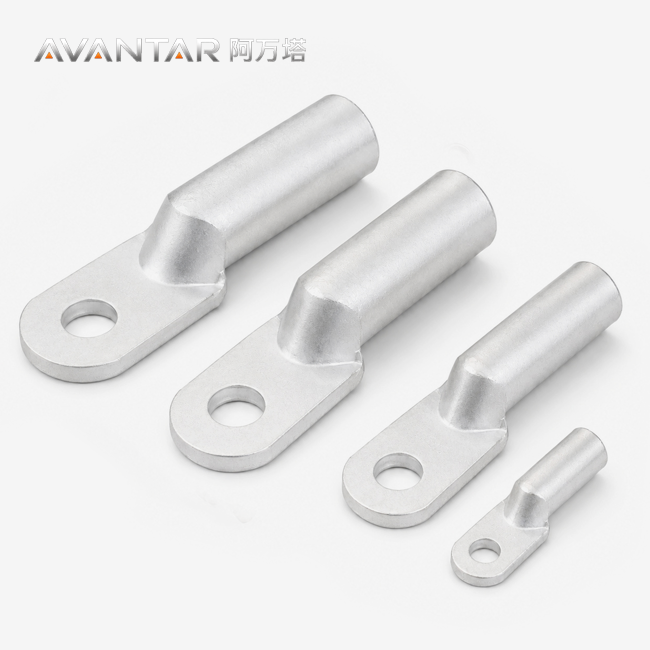
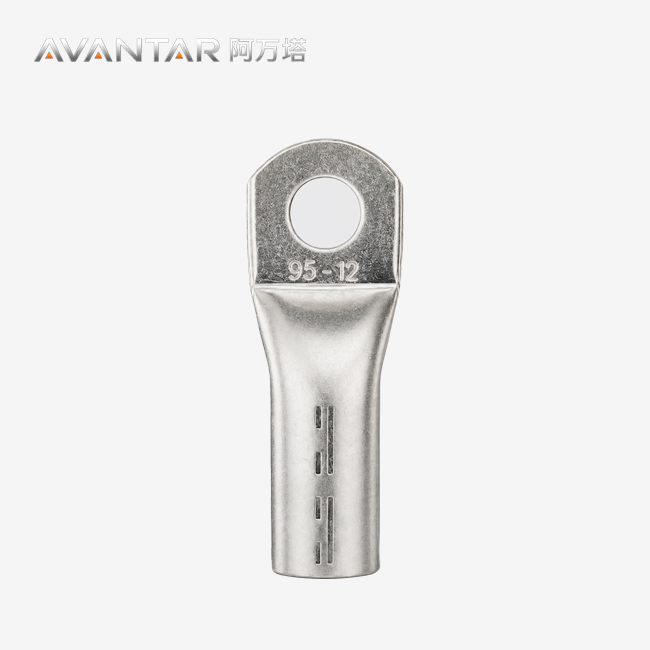
OT Ring Type: The stud goes into a closed circle hole. This kind works for connections that will stay in place on busbars, transformers, and distribution boards. Because the bolt has to be taken out all the way in order to disassemble it, it is the mechanically safest choice for high-current, low-maintenance installations.
UT Spade Type: An open-ended terminal in the shape of a fork. Loosening the bolt without pulling it out all the way lets you mount or remove the lug. This works well for control panels and circuits where links need to be changed or adjusted more often.
DT Tubular Pin Type: A pin terminal for DIN-rail terminal blocks and plug-in breakers. On one end, the barrel fits the cable, and on the other end, it plugs straight into the device interface.
Technical Specifications
| Parameter | Details |
|---|---|
| Material | T2 electrolytic copper (C11000), tinned |
| Tin-plating thickness | 3–5 μm standard; up to 8 μm for harsh environments |
| Available types | OT (ring), UT (spade), DT (tubular pin) |
| OT lug cable range | 1.5–1000 mm² |
| UT lug cable range | 1.5–95 mm² |
| DT lug cable range | 1.5–240 mm² |
| Stud hole size | M4–M20 (metric); 1/4″–1″ (imperial) |
| Barrel style | Short barrel (standard) / Long barrel (flexible cable) |
| Finish | Bright tin-plated |
| Standards | IEC 61238-1, DIN 46235, UL 486A/B, RoHS, REACH, ISO 9001:2015 |
| MOQ | 100 pieces per size |
| Standard lead time | 5–10 working days (custom: 15–25 working days) |
Applications
- Power distribution boards and switchgear — OT type with M6–M12 stud holes for busbars and breaker terminals
- Transformer primary and secondary connections — high-current OT lugs up to 1000 mm²
- Motor control centers and control panels — UT type for circuits requiring frequent servicing
- Energy storage and renewable energy systems — DT type for battery management and inverter connections
- Industrial machinery and infrastructure — applications with vibration, moisture, or chemical exposure that require a corrosion-resistant terminal
Custom Design Options
Standard catalog sizes do not cover every installation. Avantar supports the following custom configurations:
- Double-hole OT lugs — two bolt holes prevent rotation under vibration, used on large power terminals
- Long-barrel versions — for Class 5 and Class 6 fine-stranded flexible cables that standard barrels cannot grip securely
- 45° and 90° bent terminals — for installations in tight spaces where a straight lug cannot reach the stud
- Reduced-neck transition lugs — connect cables to terminals with a smaller bolt hole than standard
- Wide-pad OT lugs — wider tongue for high-current busbar contact, reducing current density at the connection point
- Custom UT fork width and DT pin dimensions — matched to specific device interface dimensions
Private labeling is available: laser marking of your logo, part number, and cable size on each lug, with custom outer packaging. Standard tooling costs USD 50–500 depending on complexity. Custom-shape MOQ is 500–2,000 pieces with a lead time of 15–25 working days after sample approval.

Samples and Pre-Order Testing
Samples of standard sizes are available before bulk orders are placed. Sample lead time is 5–10 working days. Custom-shape samples follow the same timeline but require tooling confirmation first. Crimp specification charts and material test reports can be provided alongside sample shipments.
Pre-crimped cable assemblies can also be quoted if needed.
How to Specify?
When requesting a quote for Tinned Copper Cable Lugs, provide the following details to ensure you receive the correct lug:
- Cable cross-section (mm² or AWG) — determines barrel inner diameter
- Lug type — OT, UT, or DT
- Stud/bolt hole size — metric (M4–M20) or imperial (1/4″–1″)
- Barrel style — short barrel for solid or standard stranded cables; long barrel for Class 5/6 flexible cables
- Crimping profile — hexagonal (standard for OT/DT), indent (≥50 mm² or high-vibration), square (UT and flexible cables)
- Environment — standard tin (3–5 μm) or heavy-duty tin (up to 8 μm) for coastal, chemical, or high-humidity sites
- Quantity and custom requirements — logo marking, bent angle, double-hole, etc.
Crimping Tool Guide
Selecting the correct tool and die size is as important as selecting the right lug.
- 1.5–16 mm² — hand ratchet crimping tools
- 16–120 mm² — hand ratchet or hydraulic hand tools
- 50–300 mm² — hydraulic hand tools
- 150–1000 mm² — foot-pump, bench hydraulic, or pneumatic crimp equipment
Select die size based on cable cross-section, not barrel outer diameter. Strip insulation to match barrel depth exactly. For lugs ≥50 mm², apply two crimp positions along the barrel. Do not crimp the fork section on UT terminals. Compatible tool models equivalent to Klauke and Cembre ranges can be recommended on request.
Quality and Compliance
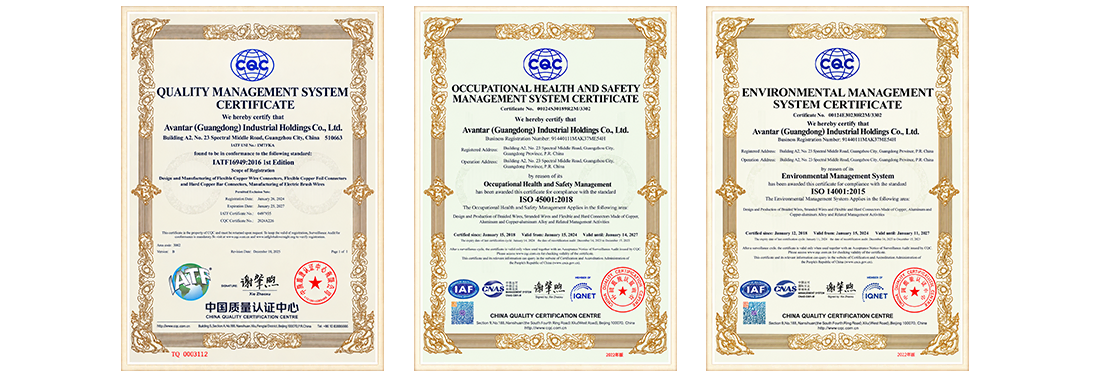
Visual inspection, measuring dimensions, sampling tensile pull-out tests, and XRF plating thickness detection on the tin layer are all done on every production batch.
Type tests include short-circuit withstand testing, salt-spray rust testing, and making sure the contact resistance stays the same after 1,000 temperature cycles. These tests are based on ASTM B545. ASTM B152 says that copper raw stuff is fine. The goods are safe and meet standards like IEC 61238-1, DIN 46235, UL 486A/B, ISO 9001:2015, RoHS, and REACH.
For every export order, a declaration of conformity and material test results are sent out. If asked, an inspection from SGS, BV, or TÜV is acceptable.
FAQ
Q: What's the difference between OT, UT, and DT types in real life?
A: OT is a ring terminal with a closed circle hole. To take it apart, the bolt has to be fully removed, which makes it the safest choice for connecting a busbar, breaker, or transformer permanently. UT is a fork spade terminal that can be attached or removed by loosening the nut instead of taking off the bolt. This makes it suitable for control circuits that need to break and reconnect often. DT is a tube-shaped pin terminal made for connecting to DIN-rail blocks and plug-in breakers.
Q: What rules do these lugs have to follow, and what do the tests make sure of?
A: IEC 61238-1 and DIN 46235 set the rules for electricity and size performance. UL 486A/B covers the safety of connectors in North America. The salt-spray corrosion test for tin plating is set by ASTM B545 and the copper material specification is set by ASTM B152. The method for managing quality is governed by ISO 9001:2015. RoHS and REACH make sure that restricted substances are used correctly.
Q: Which crimping profiles work with each other?
A: OT and DT lugs always have hexagonal crimp. Indent crimp works for lugs bigger than 50 mm² and places where there is a lot of vibration. UT fork terminals and fine-stranded wires can be used with square crimp. If you ask, you can get a crimp measurement chart.
Q: Do you make unique shapes and brand them with my own name?
A: Yes. For custom shapes like double-hole OT, long-barrel, bent terminals (45°/90°), reduced-neck, and wide-pad designs, the Guangdong facility can stamp, CNC machine, and electroplate. You can also get custom UT fork width and DT pin sizes. It is possible to laser-mark the brand, part number, and cable size, and the outer packaging can be made to fit your needs. The minimum order quantity (MOQ) is 500 to 2,000 pieces, and the wait time is 15 to 25 working days after the sample is approved.
Q: Can I get free samples before I place a big order?
A: You can get standard-sized samples before you place a bulk order. The lead time is 5–10 working days. Custom-shape samples have the same due date, but they need confirmation of the tooling first. Sample shipments can come with crimp specification charts and material test results.

Contact Us
Send your cable cross-section, lug type, stud size, quantity, and any custom requirements for Tinned Copper Cable Lugs to [email protected] and we will respond with a quotation or sample arrangement.
Learn about our latest products and discounts through SMS or email