Bimetallic Cable Lugs
2. Connection: crimp termination for aluminum conductors to copper terminals.
3. Cable cross-section: 10–1000 mm².
4. Stud sizes: M8–M20.
5. Contact finish: tin-plated copper end.
6.Lead Time: 7–10 working days
7.Customization: Flexible OEM/ODM options
Bimetallic Cable Lugs for Aluminum-to-Copper Connections
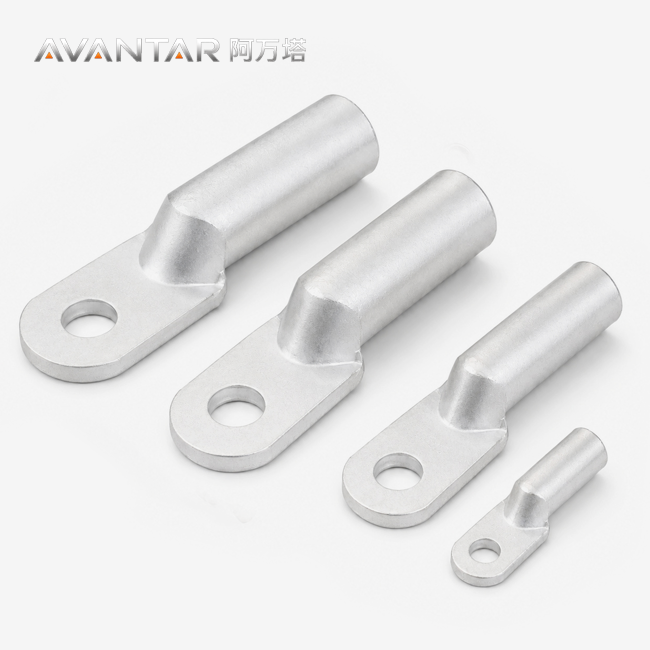
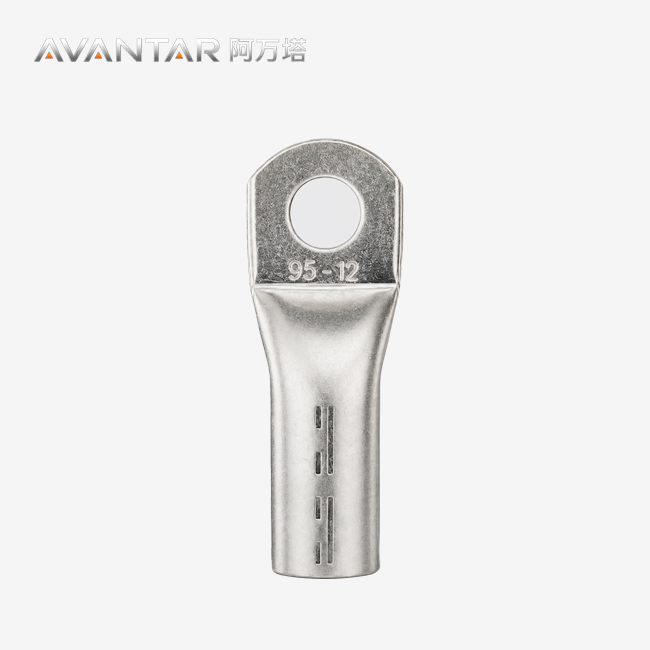
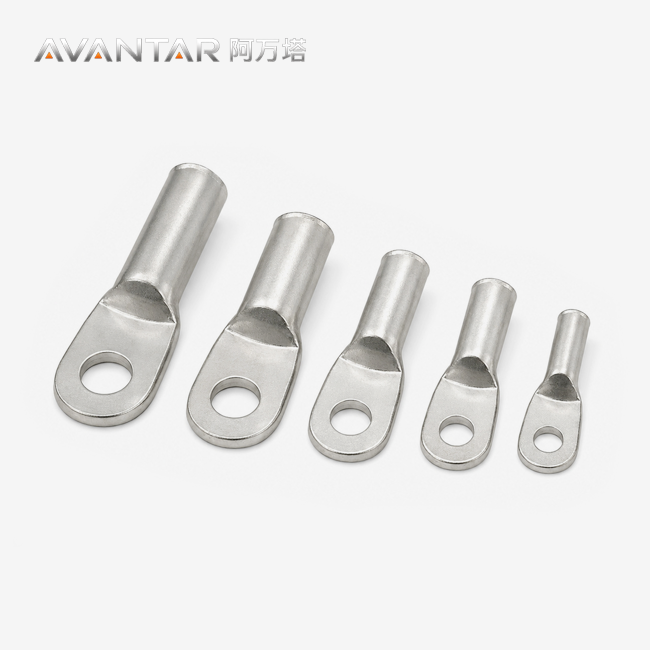
Bimetallic Cable Lugs from Avantar are friction-welded Al-Cu transition terminals designed to connect aluminum cables — ranging from 10 mm² to 1000 mm² — to copper busbars or equipment terminals without galvanic corrosion risk. The aluminum barrel uses 1050A/1350 high-purity annealed aluminum; the copper pad is C11000 electrolytic copper with 3–5 μm tin plating. Bolt hole sizes run from M8 to M20 (metric). Products comply with UL 486A/B, IEC 60502, IEC 60076, RoHS, CE, and ISO 9001.
Why Aluminum-to-Copper Connections Need a Bimetallic Solution?
First of all, connecting aluminium wires to copper terminals generates two compounding issues in actual life installations. First, the galvanic corrosion occurs at the contact surface between Al and Cu in the presence of moisture, corroding the aluminium conductor and increasing the connection resistance with time. Second, the aluminium will creep under the constant strain of the bolt and thermal cycling, loosening the joint and creating the potential for overheating.
The solutions tackle both problems by metallurgically bonding an aluminium barrel to the cable side and a tinned copper pad to the equipment side, permanently separating dissimilar metals.
Material Composition and Metallurgical Bonding
The aluminium barrel is fabricated from 1050A/1350 high purity annealed aluminium having low resistance and compatible with standard aluminium conductors. The copper terminal pad is made of C11000 electrolytic copper and has a 3–5 μm tin plating to prevent surface oxidation and minimise the contact resistance at the bolted junction.
The two metals are connected using rotary friction welding, a solid-state method that establishes a metallurgical link without melting either material. This prevents brittle intermetallic compounds which are the principal failure modes of fusion welded bimetallic connections. The tensile failure occurs in the base material and not in the weld boundary.
Technical Specifications
| Parameter | Details |
|---|---|
| Aluminum barrel material | 1050A / 1350 high-purity annealed aluminum |
| Copper pad material | C11000 electrolytic copper |
| Surface treatment | 3–5 μm tin plating on copper end |
| Cable size range | 10 mm² to 1000 mm² |
| Bolt hole size | M8 to M20 (metric); imperial sizes available on request |
| Connection type | Crimp type |
| Welding method | Rotary friction welding |
| Standard configurations | Standard flat, long-barrel, bent-type (45°/90°), double-hole |
Custom Design Options
Standard sizes cover most power distribution scenarios, but project-specific requirements often call for a different configuration. Avantar supports a full range of custom options for Bimetallic Cable Lugs, including:
- Double-hole lugs for anti-rotation under vibration
- Long-barrel versions for Class 5 flexible aluminum cables
- 45° and 90° bent terminals for space-constrained panel layouts
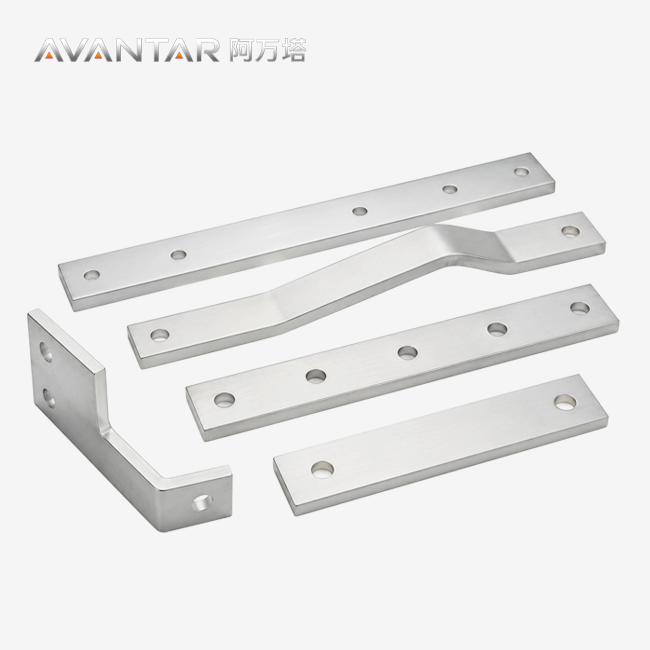
- Wide-pad terminals for transformer low-voltage connections
- Inline Al-Cu splice connectors and pin-terminal versions for plug-in devices
- Silver-plated copper pad for high-current, ultra-low-resistance applications
Custom lugs support laser-marked customer logos, part numbers, and cable size information. Custom-branded packaging and datasheets are also available.
Standard sizes: MOQ 100 pieces per size; lead time 7–15 working days.
Custom profiles: Tooling cost USD 100–800 depending on complexity; MOQ 200–1000 pieces; lead time 15–25 working days after first-article sample approval.
Quality Testing and Certifications
Each batch undergoes 100% visual inspection at the friction-weld zone, checking for weld flash and cracks. Sampling tests include:
- Axial tensile testing (failure must occur in base material, not at the weld)
- 90-degree bend test at the weld zone
- Macro-etch cross-section inspection for intermetallic layer thickness
- Phased-array ultrasonic scanning for non-bonded areas
- XRF testing to verify plating thickness
Environmental tests cover salt-spray aging and thermal-shock cycling to confirm performance in outdoor and industrial conditions.
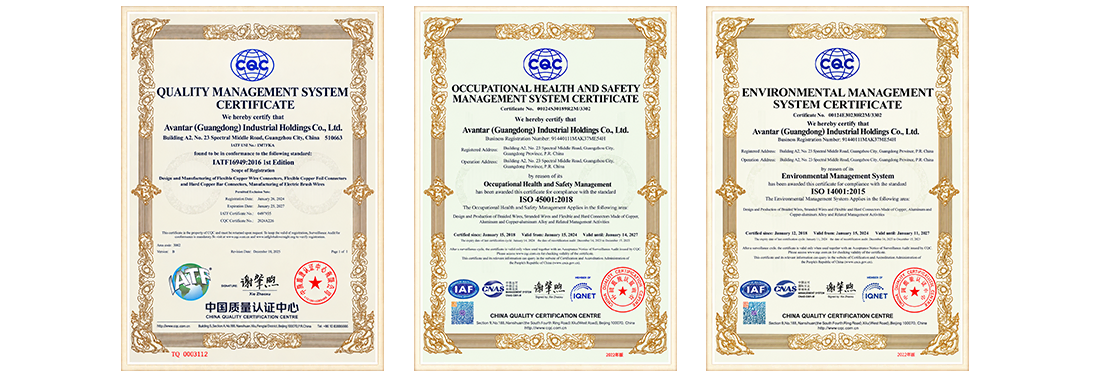
Products comply with ISO 9001, CE, RoHS, UL 486A/B, IEC 60502, IEC 60076, IEC 62561, ANSI C29.13, and IEEE 404. Export orders ship with MTR material reports, batch test records, and a certificate of origin. Third-party witness testing at the factory can be arranged for large utility projects.
Applications
These lugs are used wherever aluminum cables must terminate at copper equipment safely and reliably:
- Power distribution switchgear and transformer low-voltage terminals
- Solar and wind energy inverter and combiner box connections
- Industrial motor control centers and panel boards
- Railway and marine electrical systems requiring vibration resistance
- Electrolytic equipment requiring ultra-low-resistance, high-current connections
- Building and infrastructure projects using aluminum wiring
How to Specify?
Provide the following when placing an order or requesting a sample:
- Cable cross-section (mm²) — e.g., 240 mm²
- Conductor type — solid or stranded, Class 2 or Class 5 flexible
- Bolt hole size — M8, M10, M12, M16, or M20
- Terminal configuration — standard flat, bent angle, double-hole, wide-pad, etc.
If any parameter is unclear, share your cable datasheet or equipment terminal drawing and our technical team will recommend the correct size and configuration.

FAQ
Q: What is bimetallic cable lug? Why we need them?
A: A friction welded termination for connecting aluminium cables to copper busbars or equipment. Loose joints on direct Al-Cu contact due to galvanic corrosion from humid circumstances and aluminium creep. The bimetallic structure makes sure each metal is only touching its suitable partner, eliminating both failure causes.
Q: What cable and bolt hole sizes are available?
A: The basic range comprises cable sizes from 10 mm2 up to 1000 mm2 and bolt hole sizes from M8 to M20 metric. Imperial sizes available on request. Comes in standard, long barrel, bent type and double hole varieties.
Q: What are the crimping precautions for installation?
A: Strip to depth of barrel. Use a stainless steel wire brush to clean the aluminium conductor and coat it with anti-oxidation treatment prior to inserting it into the barrel. Use crimp dies that are rated for aluminium conductors. Keep a minimum of 5 mm away from the friction-weld area to prevent crimping the joint. After crimping, give a little tug to make sure the cable is secure.
Q: How will friction weld joint quality be certified?
A: Specific weld tests: Axial tensile tests, 90 degree bend tests at the weld zone, macro-etch cross-section inspection for intermetallic layer thickness, phased-array ultrasonic scanning. The contact resistance stability, temperature cycling, short-circuit withstand and tensile pull-out are tested according to the IEC 61238-1 standard type testing. Salt spray and thermal shock tests prove environmental performance.
Q: Can you produce custom configurations and private-label marking?
A: Yeah. Custom options: Double-hole, long barrel, 45°/90° bent, wide pad, inline splice, and silver plated variants. Supports laser marking of customer logo, part number and cable size. Custom branded container available. Standard MOQ 100 pcs. Custom profiles: tooling (USD 100-800) is required with MOQ 200-1000 pcs.
Q: How about lead times and MOQs?
A: MOQ of normal size items is 100 pcs/size, delivery period is 7-15 working days. The MOQ for items with custom profiles is 200-1000 pieces, with a lead time of 15-25 working days once the first-article sample is approved. Samples for evaluation can be ordered before placing bulk order.

Contact Us
To request samples, drawings, or a project quotation for Bimetallic Cable Lugs, reach our technical team at [email protected]. We will respond with a recommendation or quote based on your requirements.
Learn about our latest products and discounts through SMS or email